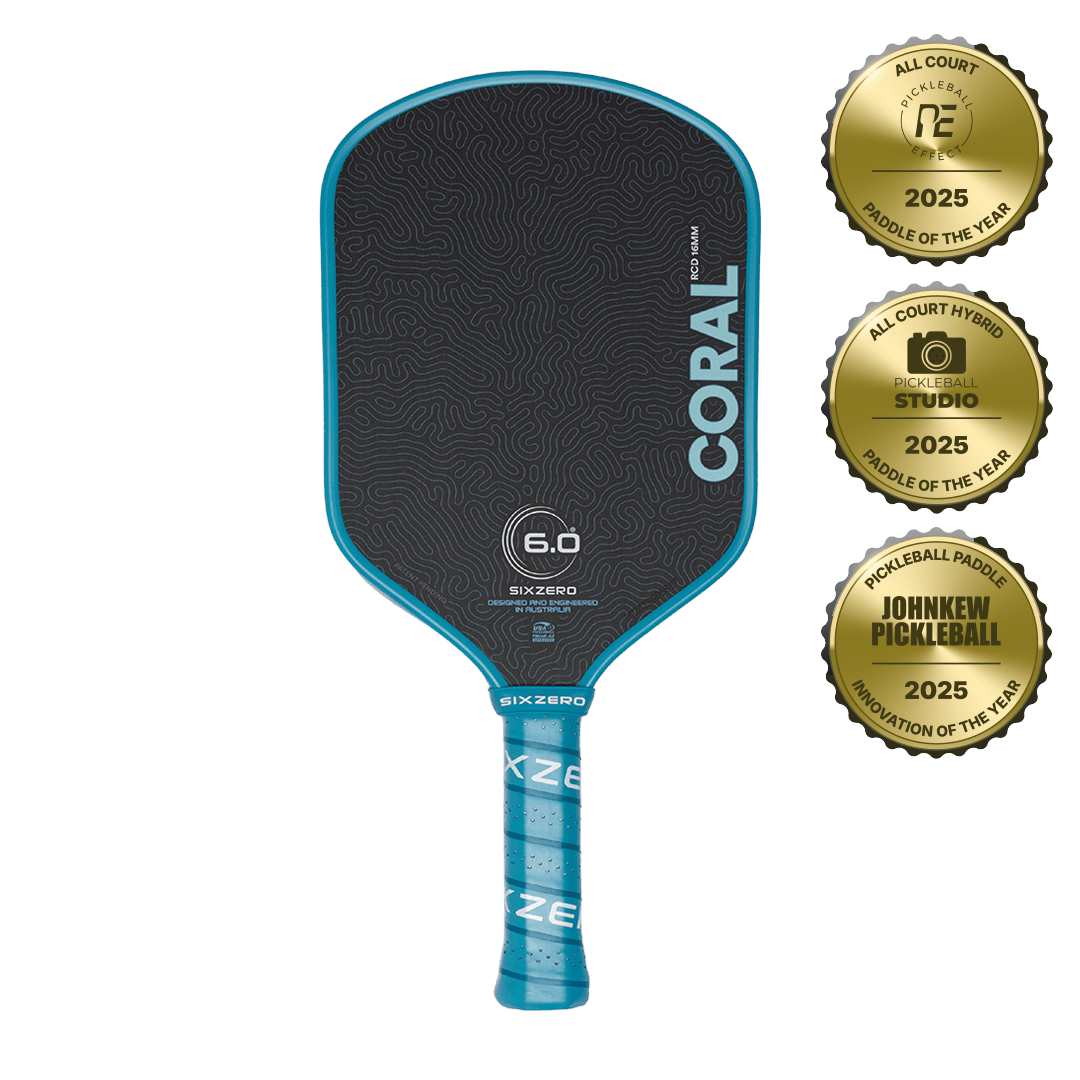
Six Zero
Six Zero Coral (16mm)
Players who want one modern do-everything paddle with a plush soft game and a clean surge of power on drives.
View paddle
The four specs that actually change how a paddle plays, and how to match them to your game.
A paddle is not one number. Four specs decide how it feels and what it is good at: core thickness, face material, shape, and weight. Get those right for your game and almost any modern paddle will serve you well. Get them wrong and even a flagship will fight you.
Most paddles run a 13mm or a 16mm polymer core. A 16mm core feels softer and more stable, holds the ball a touch longer for control, and forgives off-center hits. A 13mm core is firmer and poppier, so it rewards power but punishes mishits. If you are unsure, start at 16mm. It is the most forgiving place to learn.
Raw carbon fiber, usually Toray T700, gives the gritty texture that grabs the ball for spin and stays consistent shot to shot. Fiberglass faces are poppier and cheaper but spin less. If spin matters to you, look for a raw carbon face.
An elongated paddle adds reach and leverage for drives and serves, at the cost of a smaller sweet spot. A widebody is more forgiving and easier to control. A hybrid splits the difference. Newer players are usually happier with a hybrid or widebody.
Most paddles land between 7.8 and 8.4 ounces. Heavier paddles plow through the ball with more stability and power, lighter paddles are quicker in fast hands battles at the net. If you feel arm fatigue, go lighter. If your shots feel weak and twitchy, go a little heavier.
Still not sure where you land? Take the 30 second interview in the training section and it will point you to a category and a short list.
The mini course trains the body that plays: mobility, strength, conditioning, and recovery, from $37.